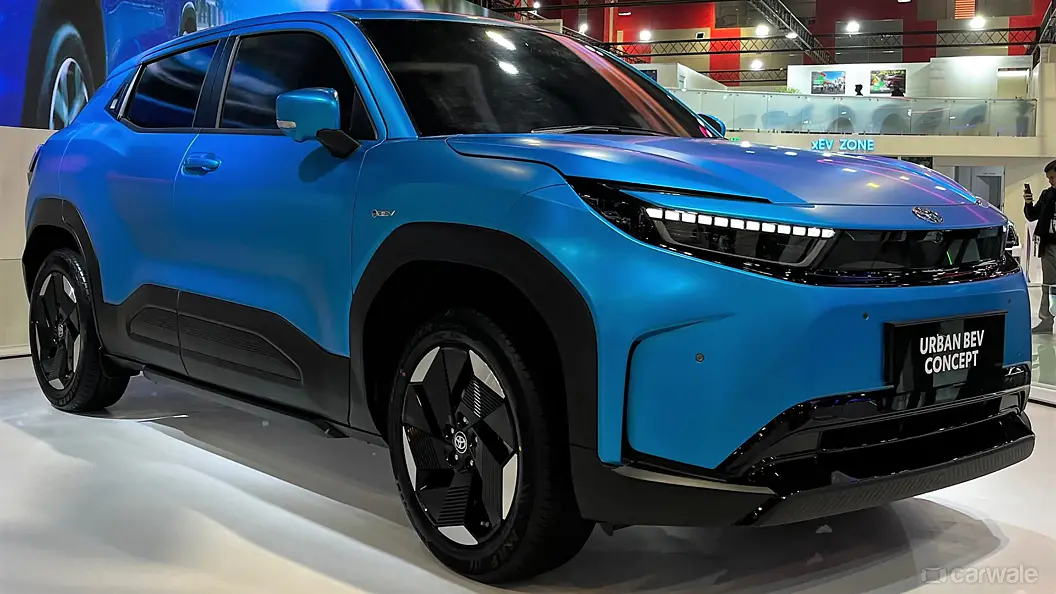
The Urban Cruiser BEV is the upcoming all-electric compact SUV from Toyota — the brand’s first full BEV offering in India — planned for launch soon, likely by end-2025 or early 2026.
It’s based on a dedicated electric platform shared with Maruti Suzuki e Vitara under the Toyota–Suzuki alliance, built at Maruti’s Gujarat plant.
The Urban Cruiser BEV combines compact-SUV dimensions with modern EV hardware aiming to offer a practical, feature-rich, and relatively affordable electric SUV for Indian roads.
Key Specifications & Power train:
Battery & Motor Options: The Urban Cruiser BEV will come with two lithium-iron-phosphate (LFP) battery packs: 49 kWh and 61 kWh.

Power & Drive:
- 49 kWh variant: ~142 bhp and 189 Nm, offered as front-wheel-drive (FWD) only.
- 61 kWh: FWD version produces ~172 bhp/189 Nm; an all-wheel-drive (AWD) variant (with a second motor on the rear axle) generates ~181 bhp and 300 Nm torque.
- The AWD setup brings added versatility — useful for better traction, possibly beneficial in wet or uneven roads — along with SUV-like credentials.
- Platform & Packaging: Built on a dedicated BEV platform (sometimes referred to as HEARTECT-e), designed without floor cross-members, maximizing interior space while accommodating the battery pack beneath the floor.
- Dimensions: Length about 4,285 mm, width ~1,800 mm, height ~1,640 mm, and a wheelbase of 2,700 mm.
Features & Interior
The cabin and features are fairly modern; matching expectations from a premium is compact EV:

- Dashboard & Infotainment: A dual-screen layout a 10.25-inch digital driver’s cluster and a 10.1-inch touch screen infotainment system.
- Comfort & Convenience: Powered driver seat, reclining & sliding rear seats (with 40:20:40 split), ambient lighting (12-colour), wireless phone charging, auto climate control, and available sunroof making it a comfortable package for city and highway driving.
- Safety & Tech: The BEV is expected to offer a comprehensive safety suite 6 or 7 airbags, ADAS (pre-collision, adaptive cruise control, lane-keep/ departure assist), 360-degree camera, ESC/ESP, ABS with EBD, and other modern safety aids.
Range & Usage
- The larger 61 kWh battery is claimed to deliver a real-world range of around 500 km (on a full charge) under optimal conditions.
- With its electric power train and decent torque especially in AWD configuration the Urban Cruiser BEV seems suitable for both urban commuting and occasional highway travel, making it a flexible choice for Indian driving conditions.
What’s good: Strengths?
- Trusted Brand & Manufacturing Back-up — Being from Toyota (built in collaboration with Suzuki) brings reliability, widespread service network, and brand trust.
- Multiple Variants to Suit Budget & Needs — From a modest 49 kWh FWD to a more powerful 61 kWh AWD, buyers have flexibility depending on their driving style and budget.
- Modern Features at Expected Competitive Price — The dual-screen setup, comfort, safety and convenience features make it value-for-money in the EV compact SUV segment.
- Long Driving Range — ~500 km claimed range addresses one of the core concerns for EV buyers in India: range anxiety.
- Practical Size + Interior Space — Compact enough for city driving, yet roomy inside for daily family use.
What Could Be Challenging / What to Watch Out For
- Real-world range and charging infrastructure: While 500 km is an attractive figure, actual range will depend on driving conditions, AC usage, terrain, etc. And EV charging infrastructure — while improving — is still uneven in many parts of India.
- Battery & After-sales Service: As this is Toyota’s first full EV in India under this alliance, real-world long-term reliability, battery health, and service readiness remain to be seen.
- Price Sensitivity: Although estimated “within mid-range” for EVs, final on-road price (after taxes, subsidies, variants) might push the cost higher — making it more expensive than equivalent ICE or hybrid SUVs.
- Competition: There will be several other EVs and upcoming EV SUVs vying for attention around same price/segment, so value proposition must stay strong.
Conclusion
The Urban Cruiser BEV feels like a very promising electric SUV for Indian conditions, provided a few things align — reasonable price, decent charging infrastructure where you drive, and realistic expectations about range.
If Toyota executes well battery reliability, real-world efficiency, service/support, variant/pricing, this could be one of the most sensible EV choices in the compact-to-mid SUV segment especially for first-time EV buyers transitioning from petrol/diesel cars.